


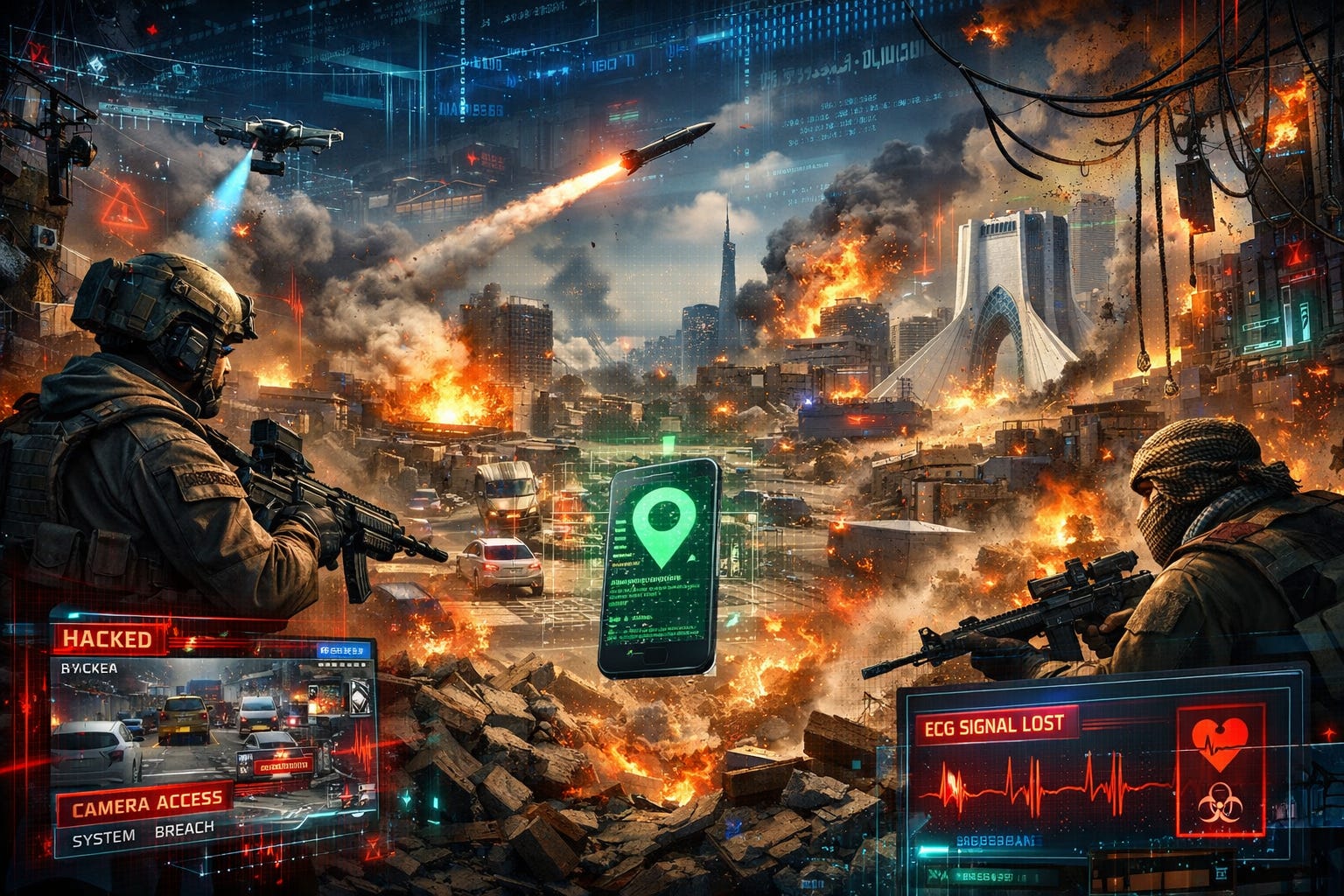
I’ve been following the cyber dimension of the 2026 Iran conflict closely, and honestly, it reads like a movie script, except it’s real, it’s happening now, and it affects all of us. So let me break it down.
On February 28, before a single missile hit Iran, U.S. and Israeli hackers had already taken over Tehran’s traffic cameras, shut down mobile networks near key targets, and even hijacked a prayer app used by 5 million Iranians to push anti-regime messages. US Cyber Command was described as the “first mover” in the war. The bombs came second.
Iran hit back. A hacking group called Handala, linked to Iran’s intelligence ministry, wiped devices across Stryker, a $25 billion American medical technology company. Employees worldwide got locked out. Hospital systems in Maryland lost the ability to transmit ECG data. A medical device company! Not a military base… it seems awkward not?
And this is the part that matters to you and me: cyberwar doesn’t care about borders.
Your gas prices? Up 17–19% because Iran closed the Strait of Hormuz (or almost), and cyber operations played a role in the escalation dynamics. Your hospital? Potentially running on degraded systems because a hacktivist group on the other side of the planet decided a medical company was a fair target. Your personal data? Already weaponizable. Israel reportedly used hacked traffic cameras and phone network data, the same kind of commercial infrastructure that tracks your Uber rides, to locate and eliminate senior Iranian officials.
And the most surprising move for me: a prayer app that asks for your location to calculate prayer times became a military intelligence tool. The same data pipeline that serves you a restaurant ad can guide a missile. There’s no technical difference between the two. Let me say that again for the people in the back: the infrastructure of your delivery of pizza is the infrastructure of modern warfare.
This isn’t new, by the way. Wars have always driven technology forward. WWI gave us radio and aviation, no? WWII gave us computers… literally, the first programmable electronic computer was built to crack Nazi codes. The Cold War gave us the internet (thanks, ARPANET) and GPS. The Gulf War showed what precision-guided weapons could do. And now, the 2026 Iran conflict is showing what happens when code becomes the first weapon fired.
Now we have vibe coders… will there be any vibe sniper around ?
Remember Stuxnet? In 2010, a tiny computer worm destroyed nearly 1,000 Iranian nuclear centrifuges without a single bullet. It was the world’s first true cyber weapon. Iran studied it, learned from it, and built its own offensive capabilities. The code became the blueprint. Unlike nuclear weapons, you don’t need centrifuges or uranium to build cyber weapons , you just need a laptop and patience (or a Lovable license).
Over 60 hacktivist groups mobilized in the first week of this conflict. No treaty governs cyber weapons. No international hotline exists for cyber de-escalation. No verification mechanism can inspect a nation’s hacking capabilities the way the IAEA inspects nuclear facilities.
We are in an invisible arms race, and every connected person is on the battlefield.
So yeah, patch your systems, question your app permissions, and maybe think twice before dismissing “privacy” as something that only matters to paranoid people. In 2026, your data isn’t just your data. It’s ammunition.
And as the AI in WarGames once said: “The only winning move is not to play.” Unfortunately, we’re all already in the game.