


I followed the terrorist attack registered at Bondi Beach in Australia this Sunday and ended up changing the topic of today’s post. I was going to talk about Christmas, Christmas promotions, and virtual scams using these holidays, but I decided to talk about a topic that was on my list of post ideas, which is the new Australian law for social media. What does this have to do with the attack? Nothing, but I brought up a subject about Australia today.
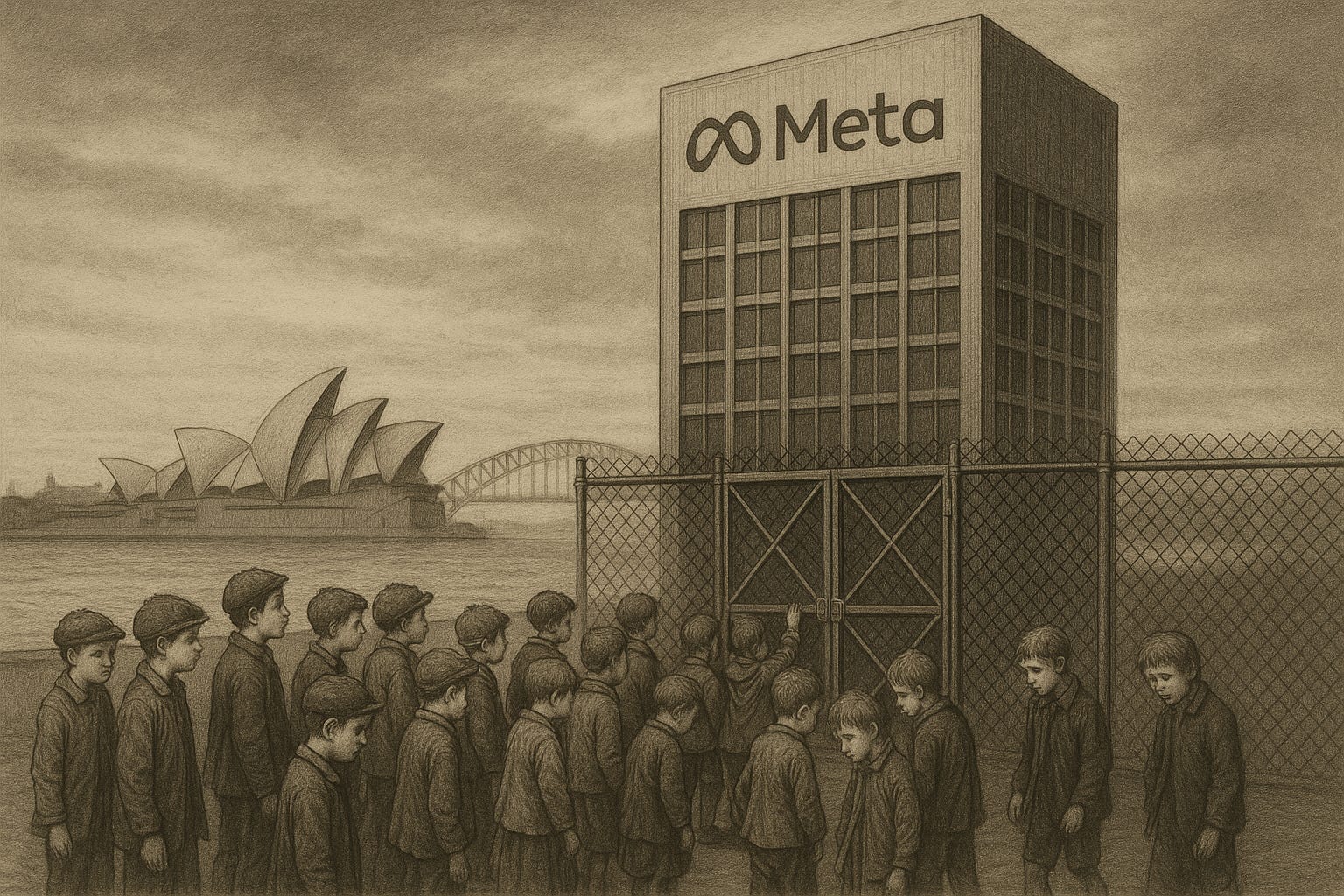
For those who haven’t heard, Australia has taken an interesting and innovative step: its Online Safety Amendment (Social Media Minimum Age) Act 2024 has banned children under 16 from using platforms like Instagram, TikTok, and Facebook... even with parental consent!
This pioneering measure signals a global trend (is it?): the European Union is discussing setting the minimum age for social media at 16, and in the United States, the Kids Online Safety Act (KOSA) proposes holding Big Tech accountable for the online safety of minors.
Well, when I was 16, my social network was Yahoo search. A very, very long time ago...
Implementing these barriers is a challenge. Technically almost unfeasible in my opinion. Age verification requires examining documents or biometrics, which is intrusive and easily bypassed by minors with fake profiles. Adapting networks for minors would require reprogramming entire systems: limiting functionalities and changing addictive algorithms means tampering with the very DNA of the platforms, whose profit depends on prolonged attention. Curbing designs made for addiction, like infinite scrolling, is swimming against the tide of the business model.
The consequences are already visible. With the Australian ban, thousands of teenagers lost their accounts. One Australian influencer complained that she will feel “cut off from the world” without her social media. Young creators fear losing not only income but also their voice and connection in a space that is a part of life nowadays. Others warn that, expelled from platforms, teenagers will migrate to corners of the internet, fleeing any supervision, such as dark web networks, which are potentially even more dangerous.
Are we willing to trust commercial platforms with the task of shaping children’s behavior? It is paradoxical to expect them to act as guardians of our children, defining what they can or cannot do online.
In the US and Latin America, the contrast is even greater: while part of the world is erecting this kind of fence, these regions lack uniform policies (and here I include where I live, Brazil, which recently approved the ECA, the Statute of the Child and Adolescent). In the US, national proposals like KOSA falter, and a patchwork of state laws prevails, some requiring parental consent for teenagers on social media, which are being challenged in courts.
In Latin America, most countries do not have a minimum online age guideline, leaving millions of young people exposed. This regulatory gap creates a no-man’s-land, where young people are at the mercy of Big Tech and its algorithms.
From a technical point of view, there is also a problem that borders on intellectual embarrassment. Blocking small children is relatively simple: parental controls, shared devices, direct supervision, and physical limits work up to a point. But from the age of 10, 12, or 13, the reality changes radically.
The modern teenager has enough technological mastery to create fake profiles, invent dates of birth, use disposable emails, VPNs, and third-party devices. Demanding that platforms “verify age” without resorting to invasive mechanisms is equivalent, in practice, to the old farce of alcohol websites that ask: “Are you under 16?” and offer two buttons: exit or enter. It has always been a staged performance of control, never a real barrier. To think that this will work now, on a global scale and facing hyperconnected young people, is to confuse regulation with desire. Without technical, and politically difficult, measures, the risk is creating only the illusion of protection, while teenagers continue to circulate freely, only invisibly, outside of any rules or responsibility (the TOR network will boom in schools).
In conclusion, I think the protection of the next generation oscillates between advances and omissions, a global imbalance that requires reflection on freedom, security, and responsibility in the digital age, and that these discussions include TECHNICAL professionals, and not just politicians and regulators.