


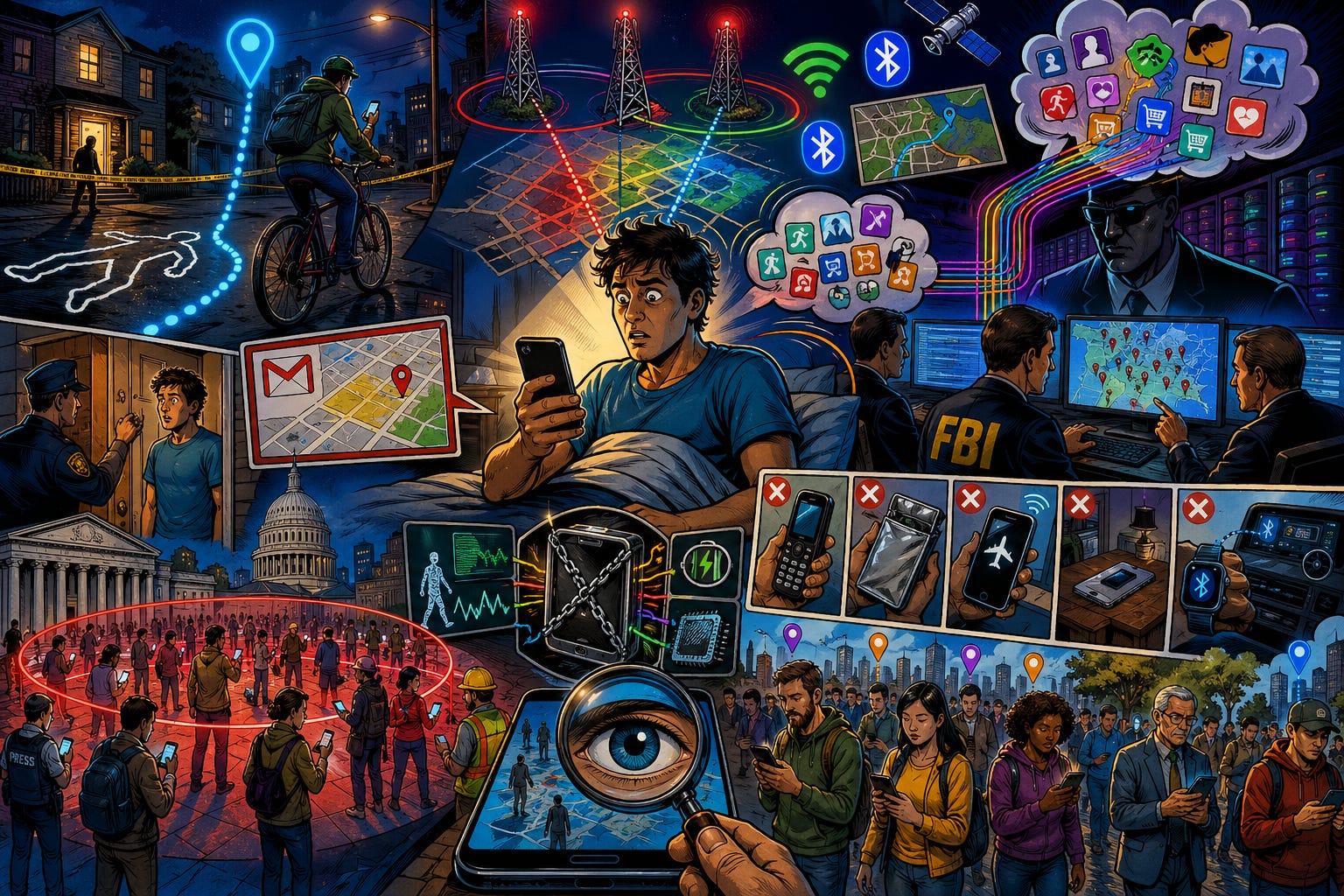
A man wakes up one morning with no idea that, three months earlier, his phone had walked past a murder scene for forty seconds. He never saw anything. He was just riding through the wrong street with Bluetooth on, location services running, and Google quietly logging his presence. Weeks later, the police knocked.
This is not hypothetical. In 2019, Zachary McCoy got an email from Google warning him that police had requested his data because he had biked past a house where a burglary occurred. He became a suspect for one reason: his phone had been there. Nothing else linked him to the crime.
Welcome to the era of the geofence warrant.
The old idea of “triangulation” is half wrong
Most people picture three cell towers drawing perfect circles around a suspect, but that is mostly Hollywood. Real cell triangulation is messier and depends on signal strength, timing advance values, sector azimuths, and sometimes a bit of machine learning to estimate a position. In a dense city accuracy might drop to around 50 meters, and out in rural areas it can be off by kilometers, which is why a tower-based location alone is rarely enough to put someone in a courtroom.
That imprecision is exactly why investigators stopped relying only on towers and moved on to something far more powerful: your phone telling on itself.
The data you do not know you are sharing
Your phone does not need a cell tower to betray you, because it leaks signals all day long. There are Wi-Fi probes broadcasting your past networks, Bluetooth advertisements with identifiers that rotate but are sometimes traceable, and GPS logs sitting cached inside apps you forgot you installed. Even quieter things give you away too: sensor fusion data from accelerometers can identify your walking pattern, and there is research showing that battery drain rate alone can fingerprint a specific device.
The FBI does not need to “hack” you. It subpoenas Google, Apple, advertising brokers, and telecoms, then assembles a timeline you yourself helped build, one app permission at a time.
This is the technique that quietly changed everything. Law enforcement defines a geographic area and a time window, then asks Google to return every device that happened to be inside it. For years Google complied through a database called Sensorvault, which held location histories of hundreds of millions of users, most of whom had no idea it existed.
In the January 6 Capitol investigation, the FBI used geofence warrants to identify thousands of phones inside the building. Some belonged to rioters, some to journalists, some to people who simply worked nearby. The technology does not really distinguish between them, and that is the uncomfortable part.
In late 2023 Google announced it would start storing location history on-device by default, partly to make these warrants harder to execute. That helps, but it is not a cure. Apple still has plenty, advertising SDKs are everywhere, and your fitness app probably knows where you slept last night.
How criminals try to escape, and why it rarely works
Burner phones tend to fail because of behavioral patterns: the burner activates at exactly the moment the main phone goes silent, which is itself a signature investigators look for. Faraday bags work fine until the day someone forgets to use one. Airplane mode is also less effective than people assume, because some chips keep emitting low-energy signals regardless of what the screen says.
Even the obvious move (leave the phone at home) creates its own suspicious profile, since a device that never moves on the day of a crime can be almost as revealing as one that does. There is a known case in which a suspect was identified because his smartwatch kept syncing to his car’s Bluetooth, even with his phone powered off. He thought he had gone dark. He had not.
You do not need to be a criminal to show up in a geofence query. You only need to exist near one.
Privacy in 2026 is not really about hiding anymore. It is about understanding that your phone is a continuous witness, recording a deposition you never agreed to give, and that one day someone may ask to read it back to you.
So… how the Hell do you turn it off within your phone..??