


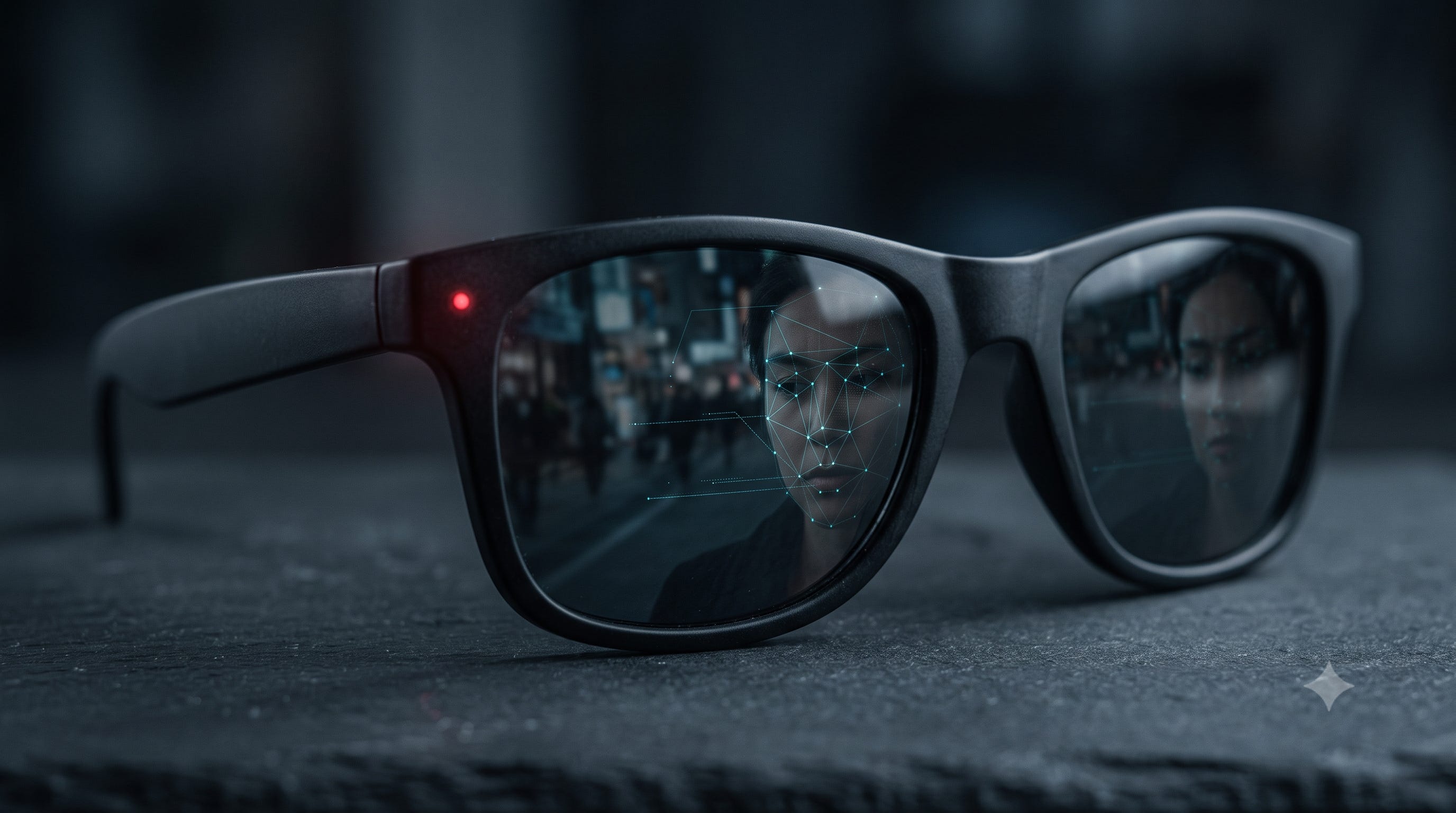
Picture the video format you have already scrolled past a hundred times. A guy walks up to a woman in a shop, on a beach, in an airport lounge, starts flirting, and the whole thing is filmed from his point of view, close and casual, like it just happened to get caught on camera. What she usually does not know is that she is being recorded at all. There is no phone held up at arm’s length. The camera is sitting on his face, inside a pair of sunglasses that look completely ordinary. The BBC found dozens of men doing exactly this to farm content off women who never agreed to any of it.
That is the version of this story everyone repeats, the creep with the hidden camera, and it is bad, obviously. But it is also the least interesting part of what these glasses actually do, and if we keep arguing about it we are going to miss the thing that matters.
The footage does not just live on the guy’s glasses. On a lot of these devices it goes up to the cloud, and some of it gets watched by human beings you will never meet. Last February, two Swedish newspapers, Svenska Dagbladet and Göteborgs-Posten, reported that workers at a subcontractor in Kenya were sitting in an office reviewing clips captured through Meta’s AI glasses, as part of the pipeline that trains the models. According to that reporting, the footage included people in bathrooms, people naked, people having sex, filmed inside their own homes. Somebody in Nairobi watched a stranger’s private moment so that a model could get a little better at understanding video. Scary, no?
So let me reframe the whole thing. We keep asking whether you consented to being on camera. Wrong question. The camera was never the point. The point is what happens to your face after the lens catches it.
And this is where it gets interesting, because the person wearing the glasses is not really in control either. They think they are. Meta sold these things with lines like “designed for privacy” and “controlled by you.” In March, two people in the United States, Gina Bartone and Mateo Canu, filed a lawsuit in California arguing that exactly this marketing gave buyers a false sense of control, because it never made clear how much of what the glasses capture gets transmitted, processed in the cloud, and reviewed by humans. The case is still early, no ruling yet. But the argument underneath it is the honest one.
The guy filming the woman on the beach is invading her privacy, yes, and he is also a subject of the same machine he is feeding. Everyone in front of the lens and behind it is raw material. Nobody is actually controlling anything.
Now, the light. Everybody’s favorite safeguard. Meta put a tiny LED in the corner of the frame that blinks when the glasses are recording, and this is supposed to be the thing that protects you, the modern version of seeing someone raise a phone. Two problems. Most people have no idea what that little light means, especially in a three second interaction on a busy street. And you can turn it off. Wired found a TikToker charging around a hundred and twenty dollars to disable the recording light completely, “stealth mode,” they called it. So the one visible signal that a stranger is filming you can be removed for the price of a cheap dinner.
Even a perfect light would not fix this, and this is the part I really want you to sit with. The light only tells you that a recording started. It tells you nothing about where the footage goes, who watches it, whether it feeds a face-matching system, whether it lives on a server in another country forever. A blinking light is a notification. It is not protection. Treating it like protection is like bolting a doorbell to a building and calling it a lock.
And the face-matching is not hypothetical. A couple of Harvard students wired one of these off-the-shelf glasses to a face search tool and showed they could look at a stranger and pull up their name, home address and phone number within seconds. Think about what that combination does. The lens sees you, the pipeline recognizes you, and suddenly a person who glanced at you across a train car knows where you live. Your face is not a password you picked. You cannot change it, you cannot rotate it, you cannot revoke it after a leak. A stolen password is a bad afternoon. A face permanently tied to your name and address in some searchable index is a different category of problem, and it does not expire.
None of this is one company’s sin, by the way. A Chinese brand called Rokid, sold in the US too, had its own mess when videos of flight attendants filmed without consent started showing up in the company’s own community forums. The hardware is getting cheap and good. Luxottica, which makes the Ray-Ban versions, sold more than seven million pairs of the Meta glasses in 2025 alone. This is not a niche gadget anymore. It is on a lot of faces, and it is heading toward a lot more.
So what do you actually do with this? The honest answer is that as the person being filmed, you have almost no power, and I am not going to pretend a clever trick fixes that. You cannot audit a stranger’s glasses on the sidewalk. That is exactly why this cannot be left to individual etiquette. The fix has to live in the product and in the law, not in your vigilance.
If you wear these things, at least know what you are agreeing to on your own behalf, because on some of them your voice and video get used to train the models by default, and turning that off is not obvious. And if you run a company thinking about handing smart glasses to your nurses, your warehouse staff, your field techs, understand that the moment footage leaves the frame you have created a data flow you are now responsible for, one that may pass through a cloud, a foreign subcontractor, and a training set. You cannot sign off on a wearable camera without knowing where the recordings actually go, who can see them, and how someone deletes them. That is not paranoia, that is just knowing your own pipeline, which is the whole point of doing privacy seriously instead of decoratively.
When Mark Zuckerberg showed up to a government hearing, his own team was told to take their Meta glasses off before going in. The people building the panopticon know exactly when they do not want to be standing inside it.
The camera you can see was never the real problem because the problem is the machine behind it, the one that takes a face it caught by accident and turns it into a record. The light tells you a recording began. It was never going to tell you where you end up. And unlike a password, you do not get to reset your face.
Exactly why I hate all this advanced technology, and run by billionaires, like Mark Zuckerberg, who has nothing better to do with his life than wreak havoc on poor unsuspecting souls.
Surveillance now is the evil thing permeating our lives. I guess there is no going back, it’s only going to get worse and used by other evil minded people in ways we haven’t even given thought to.
Our government is not even regulating technology like this. I’m sure Trump wants it this way.